
NAFN unveils 12-month action plan to boost food production, empower farmers, attract investment
By Hannah Williams
Agricultural stakeholders at the 2026 National Agricultural Show have called on the Federal Government, financial institutions and private investors to urgently address the high cost of farming, poor access to affordable loans, insecurity and inadequate market opportunities threatening food production in Nigeria.
The stakeholders also demanded increased investment in agricultural mechanisation, irrigation, modern technology and processing facilities, insisting that Nigerian farmers need practical support to increase productivity and strengthen the country’s food security.
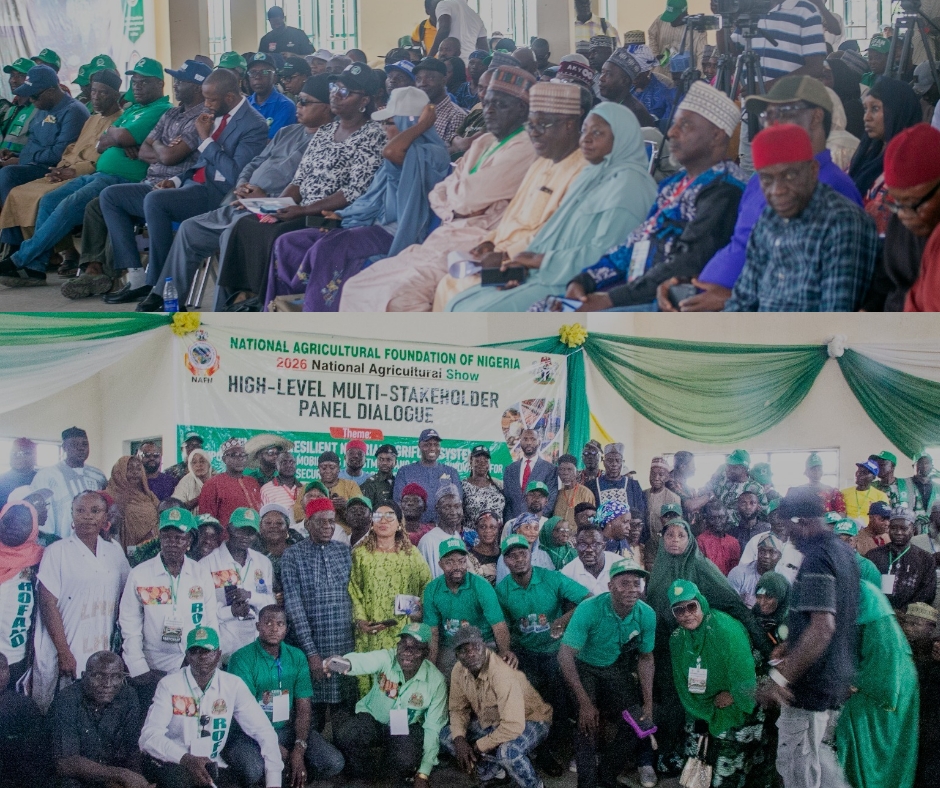
These formed part of the resolutions adopted at the High-Level Multi-Stakeholder Seminar of the 2026 National Agricultural Show, organised by the National Agricultural Foundation of Nigeria (NAFN) on Wednesday, November 18, at the Show Ground, Tudun-Wada, Karu Local Government Area of Nasarawa State.
The seminar, themed Building a Resilient Nigerian Agrifood System: Empowering Farmers, Mobilising Investment and Driving Innovation for Food Security and Shared Prosperity, brought together government agencies, financial institutions, development partners, private sector operators, researchers, farmers’ organisations, women and youth agripreneurs.
In a communiqué issued at the end of the engagement, participants called for stronger agricultural financing arrangements, simplified loan procedures and flexible credit facilities that recognise the challenges and seasonal nature of farming.
They urged the National Agricultural Development Fund (NADF), Bank of Agriculture and other financial institutions to expand access to affordable loans for smallholder farmers, cooperatives and agribusiness operators.
The seminar also called for greater transparency in the distribution of government agricultural interventions, recommending credible farmer databases, digital registration and verification systems to ensure that genuine farmers benefit from support programmes.
Concerned about the rising cost of fertilisers, improved seeds and other farm inputs, the stakeholders urged government and private suppliers to promote early procurement, cooperative bulk purchasing and improved distribution of quality agricultural inputs.
On insecurity, participants called for stronger collaboration between security agencies, state governments, traditional institutions, farmers and pastoralist communities to address farmer-herder conflicts and ensure that farmers can access their farmlands without fear.
The communiqué further stressed the need to expand agricultural mechanisation and irrigation through affordable tractors, power tillers, water pumps and equipment-leasing arrangements, particularly for smallholder farmers.
Women, youths and persons with disabilities were also identified as critical players in agricultural transformation, with stakeholders demanding improved access to land, finance, technology, training, productive assets and markets.
The seminar highlighted the National Agricultural Development Fund’s Grassroots Digital Extension Corps (G-LEAP), which involves the training and accreditation of over 1,100 extension workers and 774 food specialists to provide farmers with technical knowledge and practical agricultural advisory services.
Participants called for stronger collaboration among research institutions, universities, extension agencies and private investors to ensure that modern agricultural innovations reach farmers at the grassroots.
They also urged government to prioritise food processing, storage, packaging, quality assurance and export certification to reduce post-harvest losses, improve farmers’ earnings and position Nigeria as a competitive agricultural exporter.
Earlier, Chairman of the Seminar Planning Committee, Professor Maikano Ari, said the engagement was deliberately designed to promote a bottom-up approach that would give farmers greater opportunities to express their challenges and engage directly with institutions responsible for addressing them.
He stressed the need to move beyond repeated discussions to practical actions that would produce measurable improvements in the agricultural sector.
In her welcome address, the National Coordinator of NAFN, Hajiya Aisha Rufai Ibrahim, challenged participants to develop realistic recommendations capable of translating into visible results within the next 12 months, to be assessed at the 2027 edition of the National Agricultural Show.
A goodwill message from the national leadership of the All Farmers Association of Nigeria (AFAN) reaffirmed the association’s commitment to supporting the annual event as a platform for farmers to exchange ideas, establish partnerships and engage with critical agricultural stakeholders.
A Farmer, and the Chairman of AFAN, FCT Chapter, Hon. Perpetual Okafor, had earlier presented the challenges and prospects of farming in Nigeria, raising concerns about the gaps between farmers and the resources, institutions and opportunities needed to improve production.
Her presentation set the tone for an interactive panel session featuring representatives of the Nigerian Agricultural Quarantine Service, Dangote Group, IFAD Value Chain Development Programme and the National Agricultural Development Fund.
To ensure implementation, the seminar adopted a 12-month action plan covering agricultural financing, farmers’ capacity development, affordable inputs, security, mechanisation, inclusion, extension services, climate-smart agriculture and market development.
NAFN was urged to coordinate follow-up engagements, while relevant institutions were encouraged to designate focal persons, monitor their commitments and report progress ahead of the next National Agricultural Show.
The stakeholders maintained that farmers must no longer be treated merely as beneficiaries of government policies but recognised as business partners and key drivers of Nigeria’s economic transformation.
They expressed confidence that sustained collaboration among government, financial institutions, development partners, private investors and farmers would strengthen food production, create employment, improve rural livelihoods and promote national prosperity.