
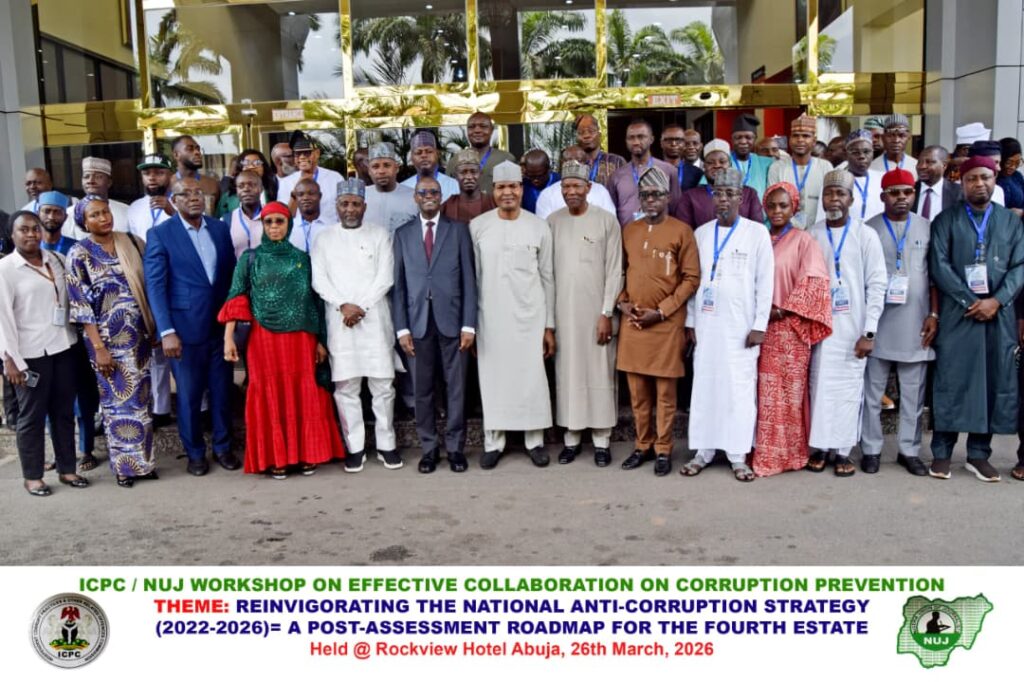
…Call for stronger protection, better training, and closer ties with anti-graft agencies
By Queen Kunde
Journalists, anti-corruption agencies, and civil society groups have agreed that Nigeria cannot win the fight against corruption through arrests and prosecutions alone, declaring that the media must take a leading role in preventing corruption before it happens.
This was the major outcome of a one-day national workshop held to review progress on the National Anti-Corruption Strategy (2022–2026) and chart a new course for the media, often described as the Fourth Estate.
Participants from across the country said corruption thrives not just because of weak laws, but due to poor systems, lack of transparency, and unhealthy public attitudes. They stressed that lasting solutions must focus on reforms, ethical conduct, and openness in government and society.
The meeting noted that although Nigeria already has a strong anti-corruption framework, there is still a gap between government efforts and what the public sees. This, they said, is caused by weak coordination among agencies, low public awareness, political interference, and slow court processes.
A major concern raised was the limited role of the media in preventing corruption. According to participants, journalists often focus on reporting arrests and scandals instead of exposing the loopholes that allow corruption to happen in the first place.
They also pointed out that modern tools such as digital forensics and artificial intelligence, which could strengthen investigative journalism, are not yet being fully used in Nigeria’s anti-corruption efforts.
To address these challenges, the workshop proposed the creation of special media desks within anti-corruption agencies to provide journalists with timely and reliable information. This, they said, would improve transparency and support fact-based reporting.
Participants further called for stronger legal protection and incentives for journalists and whistleblowers, warning that without safety guarantees, many cases of corruption will remain hidden.
They also recommended regular training programmes to help journalists better understand key areas such as public finance, ethics, and accountability, enabling them to report more effectively.
The workshop urged the media to shift its focus from “prosecution-only” reporting to “prevention-first” journalism by highlighting reforms that work and identifying risks before public funds are lost.
In addition, stakeholders called on the National Assembly to quickly pass stronger whistleblower protection laws to safeguard sources and encourage more people to speak out.
A joint monitoring committee made up of government, the media, and civil society organizations was also proposed to track progress and review the anti-corruption strategy every three months until 2026.
Participants praised the efforts of anti-corruption agencies but warned that poor funding could weaken their operations. They called on the Federal Government to provide adequate financial support to sustain the fight against corruption.
In their closing remarks, the organizers emphasized that a free, protected, and well-trained media is essential to building a corruption-free Nigeria.
They reaffirmed their commitment to working together to ensure the success of the National Anti-Corruption Strategy, stressing that without a strong and active Fourth Estate, the fight against corruption cannot be won.