
By Queen Kunde
Germany’s Ambassador to Nigeria, H.E. Annett Günther, has reaffirmed her country’s commitment to deepening relations with Nigeria, describing the partnership as strategic, dynamic, and mutually beneficial.
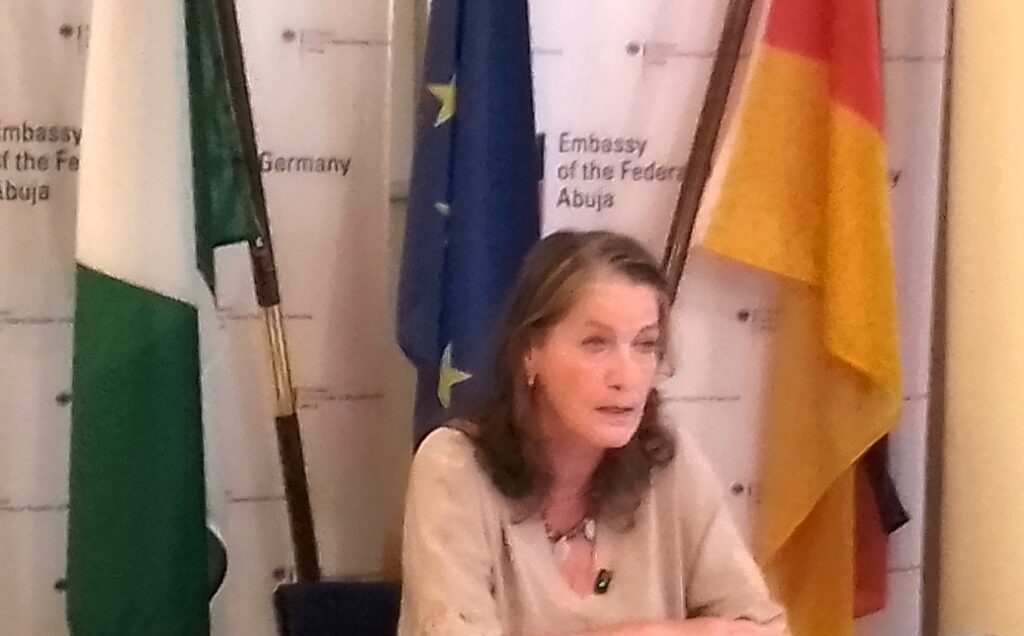
Speaking during a media briefing at the German Embassy in Abuja on Thursday, October 23, 2025, Ambassador Günther said Nigeria remains Germany’s second-largest trading partner in Sub-Saharan Africa, with trade volume now hitting three billion euros — a 30 percent growth this year alone.
She disclosed that over 90 German companies currently operate in Nigeria, supporting about 17,000 jobs and investing heavily in the energy, pharmaceutical, and manufacturing sectors.
The envoy noted that both nations are preparing for the Nigeria–Germany Binational Commission meeting scheduled for November 2025 in Berlin, to be co-chaired by the foreign ministers of both countries. The forum will address wide-ranging issues including trade, power, climate action, migration, education, and security as the two countries celebrate 65 years of diplomatic ties.
“Both Nigeria and Germany are Federal Republics, the most populous and most powerful economies in their regions. We share democratic values and believe the world should be governed by the strength of the law, not the law of the strongest,” she said.
On energy, the Ambassador highlighted progress under the Presidential Power Initiative with Siemens, now in its second phase, expected to add seven gigawatts to Nigeria’s national grid. She also emphasized growing collaboration in the gas sector, targeting gas-flare reduction and improved environmental sustainability.
In the security sphere, Ambassador Günther announced the launch of the first Bilateral Annual Military Program, designed to enhance joint planning and counter-terrorism training. She added that Germany has provided about nine hundred thousand Euros in police reform support between 2024 and 2025 including training 600 instructors, refurbishing training schools, and promoting gender inclusion within the police force.
Turning to humanitarian issues, she raised concern over Nigeria’s worsening food insecurity and malnutrition, pledging Germany’s continued support for humanitarian relief, stabilization, and climate-resilience projects. A flagship effort, she said, is the reconstruction of Ngarannam village in Borno State, destroyed by insurgency but rebuilt with homes, schools, and livelihoods.
In education and culture, she announced that the Goethe-Institute has expanded operations to Abuja and that new collaborations with Nigeria’s film industry are planned for 2026. On migration, she revealed that the German Embassy and Consulate General issued over seven thousand six hundred visas last year, covering studies, employment, and business travel.
Reaffirming Germany’s long-term partnership with Nigeria, Ambassador Günther said:
“Much can be achieved together if we realise how much we have in common and how closely our interests align.”
As both countries look ahead to the Berlin Binational Commission, expectations are high that Nigeria and Germany will chart a renewed path for cooperation one anchored on trade, clean energy, good governance, security, and cultural exchange reinforcing a 65-year friendship between Africa’s largest democracy and Europe’s biggest economy.